
Major G. Rees-Jones LL.B., RFD, ED (Rtd) – The Court Martial of CAPT C. L. Rule
The Court Martial of CAPT C. L. Rule
Written by Major G. Rees-Jones LL.B., RFD, ED (Rtd)
Copyright 1990 Graeme Rees-Jones
Other titles by this author
The Sunbury Pop Festivals 1972-1975
eBook Edition, License Notes
Thank you for downloading this free ebook. You are welcome to share it with your friends. This book may be reproduced, copied and distributed for non-commercial purposes, provided the book remains in its complete original form.
Table of Contents
The Court Martial of CAPT C. L. Rule. 1
I could not believe it. As I sat in the barber’s shop at 8.30am on Thursday the 28th March 1968 in Frankston, reading the headline of the Sun newspaper “Viet Veteran Arrested” and saw the name of Capt Rule, I knew this had to be a muck-up. From that point onwards, nothing has happened to change my initial impression.
The whole story is fascinating and in many ways a bizarre example of how the military system, subjected to the blaze of media exposure, handled a drama which could and should have been avoided. To tell the whole of the story in detail would take too long so I will attempt to summarize it, acknowledging the risk of inaccuracy and incompleteness.
Capt Clarry Rule and his twin brother Capt Richard Rule were called up for National Service in 1952 and transferred to 4th/19th Prince of Wales’s Light Horse later that year. Their career paths and postings were parallel and they were commissioned in 1959 and promoted to Captain in 1964. Both were always highly regarded as very capable, energetic and conscientious officers, much respected and admired.
When the Australian Government committed more forces in Vietnam, volunteers were sought from the CMF to undertake full time duty. Capt Clarry Rule was chosen after several interviews. Following six months training, he was selected for duty in the Australian Army Training Team (Vietnam) (AATTV) and left in September 1966 for the Ranger Training Centre at Duc My. Only four months later, as Operations Officer on the United States Headquarters for the Phuoc Tuy Province and as senior Australian Advisor in US 111Corps responsible for a team of Australian Warrant Officers, he actively participated in operations. In May 1967, he was posted to Long Dien and almost immediately became the Senior District Advisor to the District Chief, a post he held for the next ten months.
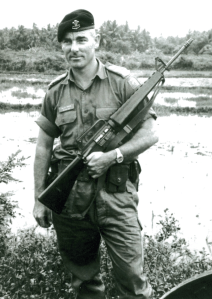
Capt Rule was also the senior Australian Advisor in the province. With company size groups, he took part in about eighty operations including thirty ambushes, heliborne assaults and quick ready reaction counter attacks. He also flew in light aircraft as an Air OP for Artillery and for US air strikes. Throughout those ten months, the Long Dien District was the most active Vietcong area in the province and there was daily contact during the Tet offensive. Government forces were mortared and rocketed regularly, the outposts constantly attacked and there were many killed and injured in Capt Rule’s compound.
On Capt Rule’s departure from Long Dien in March 1968, the District Chief who was the target of assassination squads paid him the compliment of escorting him all the way to Vung Tau as a sign of sincere friendship. He received glowing letters of commendations from senior US and Australian officers.
Of course, I am very conscious that these few paragraphs are a totally inadequate narrative of an 18 months tour of duty and I hope that someday Capt Rule will write his own story of the events. However, in the meantime, I quote in full a letter of appreciation written to the Commander of Australian Forces on 13th April 1968 by the Senior US Advisor in Phuoc Tuy Province:
“1. This headquarters wishes to express its sincere appreciation for the valuable service rendered by Captain Clarence L. Rule in Phuoc Tuy Province. Captain Rule served as an Operations and Training Advisor in the Sector Headquarters and as a District Deputy Senior Advisor prior to August 1967. At that time, he volunteered to extend his tour of duty to become the District Senior Advisor in Long Dien District. Although this position is normally filled by a U.S. Major, a shortage of American field grade officers and the demands imposed by the reorganization of the US Advisory effort, made it highly desirable that Captain Rule accept responsibility for the District advisory team in Long Dien, where he had previously been the deputy.
2. When Captain Rule first assumed direction of the district team, there was very little dialogue with the District Chief who had repeatedly been recommended for relief by the former District Senior Advisor. Captain Rule made it his first order of business to establish effective communication with the District Chief and other district officials. His counterpart was a very taciturn and dour looking Vietnamese Captain who was reputedly arrogant and uncooperative towards his advisers. Within two months Captain Rule had effected a very noticeable improvement in rapport with his District Chief. Captain Rule’s sincere, courteous, and helpful attitude fostered mutual respect and made it much easier to influence the actions of the District Chief whose overall performance improved during this period.
3. The state of readiness, training and discipline of the two Regional Force companies in Long Dien had been so poor that withdrawal of Military Assistance Program (MAP) support had been recommended. With the benefit of Capt Rule’s advice and material assistance these units made considerable progress and this drastic action was not necessary. In fact, all Regional and Popular Force units of the district showed some improvement due to the increased interest and attention of the District Chief and his advisor. Both of these gentlemen participated in numerous combat operations with district forces which showed greater promise than previously.
4. In October 1967, the District Chief survived a change of Province Chiefs, and in November he was promoted to the grade of Major. During this same month the district capital suffered a sudden Viet Cong attack. Captain Rule’s performance during this action was highly commendable. Many of his recommendations for better defences and alert procedures were heeded by the District Chief.
5. During the VC TET offensive, Long Dien suffered more from hostile action and friendly reaction than any other district. In particular, the Long Dien District Compound withstood more enemy attacks than any other advisory group in the province. Throughout these actions Captain Rule’s conduct was exemplary. He effectively coordinated friendly air and artillery support as well as the actions of Vietnamese and Australian combat units.
6. In one instance he directed the evacuation of several wounded Australians with complete disregard for his own safety. To those who have served directly with him, his personal bravery in battle was notable.
7. He left many genuine friends among the Vietnamese people when he departed as he had become an accepted and respected citizen of the community by participating properly in their social activities. Most important, however, he re-established advisory communication with a District Chief who is still in office. During his tour here Captain Rule made a significant contribution to the pacification effort in the Republic of Vietnam.“
Instead of returning home to a hero’s welcome with honours and awards which he had obviously deserved, Capt Rule was placed under close arrest, later charged with offences and was subjected to one of the longest and most public Court Martial in Australia’s history.
To understand how that might happen, perhaps you need to know the Capt Rule brothers; perhaps you need to have served in the CMF in that era; perhaps you need to remember the political sensitivity of Australia’s participation in the Vietnam war and finally you need to be reminded that here was an essentially bureaucratic Regular Army system dealing with a very delicate situation in the glare of political and media scrutiny.
Capt Rule was always conscientious and he expected, on his return to Australia, to use the experience he had gained in training others for this type of warfare. Knowing well the lack of equipment, information and training aids, he collected from various places, documents such as Operation Orders and reports and weapons or equipment of interest. Indeed, he had been encouraged to bring home items of military interest. Some he posted home and some he had sent through the Army system, some he brought back with him by plane.
Capt Rule’s parcels were posted through the Army Postal Service to his home in North Box Hill in Melbourne. Of course, the parcels were opened by customs officers for inspection and they found pieces of military equipment and documents marked “SECRET”. Doubtless much consternation ensued! The Military Police were informed. The senior Intelligence Officer at Southern Command was consulted. The facts were relayed to Army Headquarters for consideration and decision. In one parcel they found some ammunition which had not been declared on the customs declaration which stated that the parcel contained personal effects. They also found his diaries which referred to posting other parcels. What had they discovered – a spy, a smuggler or an officer who had just ignored the system? Could they take the risk? However, bear in mind that Capt Rule was about to return home when these discoveries were made and the circumstances had to be investigated.
Back in early March in Saigon at Headquarters Australian Force Vietnam, two relevant things happened – first, Capt RuIe was tried summarily before the GOC on charges relating to the postage of the ammunition and the false Customs declaration. He was given a severe reprimand! Secondly, he was interviewed by Army Public Relations for an article on the Tet offensive in Long Dien and on Vietcong activity and the progress of pacification. He asked that the article be shown to him before release for publication. That was not done but he was quoted in an article in the Melbourne Sun newspaper and a tape of the interview was played on a Melbourne radio station. Both caused concern in Australia – even though they were released by Army Public Relations in Saigon.
When he arrived at Mascot in Sydney at 11.50 p.m. on Monday the 25th March 1968, Capt RuIe was warned by the OC of Eastern Command Personnel Depot that he must not make any statements to the press, TV or any other media. However, his brother told him by phone from Melbourne that the Sun reporters wanted an interview on arrival in Melbourne and that they would be at Essendon airport. They could not be dissuaded.
At Mascot, Capt Rule was met by his lovely wife June who had – romantically -made reservations for two nights in a Sydney hotel, so instead of boarding the special flight to Melbourne at 2.30 a.m., he obtained a leave pass and an open airline ticket to Melbourne for the following Wednesday but that information was not relayed to Melbourne or AHQ.
So here is the recipe for drama. THEY thought there was a loud-mouthed CMF officer smuggling weapons, ammunition and classified documents who did not arrive on the 2.30 a.m. flight as expected. So now they had an absconding loud-mouthed CMF smuggler! The order went out to arrest him!
When Capt Rule and his wife arrived at Essendon airport, his children, his parents, his brother Richard and his wife Ronnie and their children, together with family friends were there to welcome him. The Sun newspaper reporters were there for an interview. Also present, in the background were Maj Ken Petersen the Deputy Assistant Provost Marshal of Southern Command, three plain clothes Special Investigation Branch men and two Provost Corps chaps. Capt Rule barely had time to greet his family when he was told by the DAPM that he was under close arrest on a charge of failing to obey a lawful command in that he did not board the 2.30 a.m. flight from Sydney when ordered to do so. He was taken to the Special Investigation Branch and then driven to his home in North Box Hill where his house was thoroughly searched, with his consent, by a party of ten people. His wife was advised not to go back to their house. What a welcome home!
The search revealed a cache of pyrotechnics accumulated over years of CMF camps and weekends for later use in training, as they were always in short supply.(Every officer in the Regiment had such a cache which was quickly re-located when the word spread!) After the search, Capt Rule was taken to Watsonia, in custody and kept overnight under the watchful eye of an escort officer. During the search and during the car ride there were some “discussions” with Provost WO2 Shaddock which “discussions” became of later importance.
Of course, the arrest had been witnessed by the Sun newspaper reporters who knew something of Capt Rule’s deeds at Long Dien. So, instead of a story on the home coming of a brave CMF Officer, they printed in bold type on the top of the front page for Thursday 28th March 1968 “Viet Veteran Arrested” and the dramatic story.
Later that day, at 6.30 p.m., Capt Rule was charged with two offences of conduct to the prejudice for posting classified documents and improper possession of his cache of pyrotechnics.
Unknown to him, after I had recovered from the shock of the Sun report which I read in the hairdressers in Frankston, I went back home to Mt. Eliza to make many phone calls. There was no answer at either of the Capt Rules’ homes – they were avoiding the newshounds and had gone into hiding. I tried to speak to Capt Rule at Watsonia, but I was not allowed. I left a message with the OC that I had phoned. I rang Lieutenant Colonel Brian Clendinnen, the CO of 4th/19th Prince of Wales’s Light Horse Regiment and told him that I could not obtain instructions as I could not find a client. I well remember that he said, “I thought the whole Regiment was your client!” So then I phoned Lieutenant Colonel Sel Pearson the Assistant Director of Army Legal Services who was the senior Legal Corps officer in Southern Command, told him of my interest and that I wanted access to my client, particulars of the charges and an indication as to the time of his release. When I received no satisfactory answers after several hours, I phoned him again and threatened a Writ of Habeas Corpus. Late that afternoon, I was told that Capt Rule would be released at 7.00 p.m.
So I drove to Watsonia and collected a very tired, bewildered officer and took him for a meal and then to the Park Street depot to meet his mates at the Regiment. Next day the taking of the Summary of Evidence was adjourned for two weeks at our request. Capt Rule and his family managed to avoid the relentless press and TV reporters. Fortunately, they had more success in preventing publicity than I had in keeping the well-meaning politicians quiet in Canberra. Unfortunately, the Minister for the Army, Mr Phil Lynch, had made an ill-advised statement in the House and thereafter various Members asked silly questions which only made the situation worse.
I sent the following message to the Speaker, Mr Billy Sneddon:
“I shall be pleased if you will inform the Members of the House that, as Capt Rule’s legal adviser, I am satisfied that the matter is being correctly handled in accordance with the provisions of military law. I feel some concern that the publicity which follows questions and statements in the House, will ultimately prove prejudicial to the proper handling of the proceedings and a fair trial at any Court Martial which may follow. Whilst appreciating and sharing some of the concerns expressed by Members in this matter, they may be assured that, if Capt Rule’s advisers consider any aspects should be debated by Parliament, there will be no hesitation in arranging for that to be done. Meantime, I ask that the case be allowed to take its proper course, free from the pressure occasioned by such publicity.“.
Rumours were rife. There was constant publicity and the Army was very sensitive and nervous. The Assistant Adjutant General at Southern Command told me privately, that the whole thing was a muck-up (how could I disagree) and that his headquarters was merely acting as a post office for Army Headquarters. Of course, the Army had a very real dilemma. A CMF officer with a commendable service background had been publicly arrested, the Minister for the Army had made an incorrect and prejudicial statement in Parliament and the whole drama was very public – yet, on the other hand, there were many saying that Capt Rule was a good guy and his actions were minor, technical breaches and perpetrated for acceptably conscientious military reasons.
I spoke to everyone that might exercise some influence to bring common sense to bear- the Minister for the Army (Mr Phil Lynch, who I knew quite well from University days and I knew him socially as my Local Member), the Secretary to the Department of Army, the Adjutant-General – Major General Long, the CMF Member on the Military Board- Major General Vickery (who I knew very well), other generals, senior officers and Honorary Colonels. Everyone who knew Capt Rule agreed he would not wilfully do anything wrong and that whilst he may have breached some procedures, certainly nothing to warrant a Court Martial.
On instructions from Capt Rule, I even offered that he plead him guilty to minor charges if they were to be heard summarily and in private to save publicity and embarrassment to the Army.
As far as I was concerned, the only person who provided any real sense and reason was the Secretary to the Department of the Army, Mr Bruce White, who phoned me after a midnight phone discussion with the Minister. We had a “meaningful” discussion and whilst obviously on opposite sides of the fence, we established a good rapport. Later, he was very helpful in cutting red tape and in expediting some of my requests. He was always proper, firm but friendly and I admired him. On some points we agreed to disagree but I admit to partisan bias because I knew Capt Rule but he didn’t. He was proceeding on principle and adherence to the systems for the discipline of an Army at war. There was the dichotomy – the maintenance of the system or the consideration of the individual. I asked that they think carefully.
Despite those efforts, the GOC of Southern Command, Major General Knights, on the 10th May 1968 signed the Convening Order for a General Court Martial to be conducted at Watsonia on the 15th May which, excluding the weekend, left two days’ notice.
Remember that Capt Rule was arrested on the 28th March and six weeks later he and his advisers were expected to face 8 very serious charges. The taking of the Summary of Evidence had only been completed two days previously. Has anyone known the Army to move so quickly?
I had tried everything to stop the military system from displaying idiocy in public. Now let battle commence.
Despite subsequent inquiries, I have never been able to discover exactly who made the decision to proceed. I know who didn’t and I am left with a strong suspicion as to who it was.
Obviously, this was going to be a long and expensive trial and it would be necessary to brief counsel experienced in criminal trials as well as one familiar with military matters. I asked that the legal costs be paid by the Commonwealth and the request was granted, much to my relief. We needed time properly to brief counsel but no adjournment would be granted administratively, so I had to apply to the Court.
The glare of publicity continued. Understandably there was a general feeling in the CMF that Capt Rule was being harshly treated by the system – railroaded and being made an example to others (particularly to the Regular Army) who had done similar things.
I assessed that media sympathy would be of prime importance, so one of the regimental officers who ran a PR business, was appointed our media relations adviser and given details on all aspects. Several TV and press reporters attended a briefing in my office and I offered to help them understand the legal and military technicalities. That turned out to be very useful move.
On the 15th May 1968, the Court Martial assembled at Watsonia in the gymnasium of the Psychology Centre, which some thought an apt location. The media were there in force and so were the 4th/19th PWLH officers to lend support. The Regiment to a man had closed ranks and so did the CMF. Before the Court opened, the Prosecutor, Col Ewing, told me that he would regard any mention of a second Charge Sheet as being a breach of the Official Secrets Act. I merely responded “Oh really Colonel!“. Of course the media already knew!
After the formalities, my application for an adjournment of two weeks was granted and we went away to brief counsel. Two weeks is not really much time to prepare for a big trial and I was fortunate in having a WRAAC officer (Lieutenant Sue Bolton) as my secretary because she could understand military abbreviations.

Mr Neil McPhee of counsel was briefed to appear for Capt Rule. Mr McPhee had been a regular Army officer who had served with 3RAR in Korea. When he left the regular Army to study law, he joined MUR and attained the rank of Major. I knew him quite well. At the Bar, he had established a reputation as an able and fearless advocate. I was delighted when he accepted the Brief and I delivered reams of documents to him – proofs of evidence, charge sheets, summaries and press clippings; we held conferences.
On 29th May 1968, the Court re-convened. The President was Brigadier Richardson, the Director of Supplies and Transport at A.H.Q. The members were CMF officers Lieutenant Colonel Frank Poke, Major Neville Reynolds and Major Bruce Addis with an ARA Major Noel De La Hunty MC. The Judge Advocate was Capt David Bristol of the Army Legal Corps – who had the reputation of having been the most escaped prisoner of war in World War 2 and was a reputable and successful suburban solicitor. The Prosecutor was a Colonel Maurice Ewing, the Director of Army Legal Services.
Capt Rule was facing 8 charges – five on the first Charge Sheet and three on the second Charge Sheet. In summary, the first charge sheet had three charges of Conduct to the Prejudice in the posting of classified documents, one charge of improper possession of a prismatic compass and one charge of fraudulently altering an authority to bring firearms into Australia. The second Charge Sheet had two charges of Conduct to the prejudice for failing to declare and surrender weapons on his arrival at Mascot and for being improperly in possession of two magnetic compasses at his home and finally unlawful possession of his cache of pyrotechnics at his home. There was no mention of the charge of failure to obey the command to catch the special plane flight for which he had been arrested. However, they all sounded very serious accusations until you stopped to listen to Capt Rule’s explanations – which of course no one had!
The gymnasium in the Psychology Building at Watsonia was quite large. On entering the door- to the immediate front there was a raised stage with tables and chairs for the Court Martial Board members. The Prosecution had a table on the right and the Defence had a table on the left of the stage, both at floor level. The witness box was between the Defence table and the stage. The tape recorder operator had a table on the far left and there were several tables for the press on the far right. There was seating for spectators in the body of the room, separated by an aisle from the front door to the stage. An orderly guarded the door. The Board, the Prosecution, the Defence and the press had separate small conference rooms outside the Court area.
The Board members looked very impressive in full dress, medals, Sam Brownes, swords and headdress. The ARA Major, who had been awarded a MC in Vietnam, had a very impressive array of medals which clanked when he moved – which was often – and seemed in stark contrast with Capt Rule, who sat quietly behind his counsel, with no Sam Browne, no sword or medals for his bravery, only his two Vietnam service ribbons. His escort officer also with sword in full uniform, sat next to him. There was much stamping of feet, shunning and un-shunning, saluting and all that good military stuff. Mr McPhee and the Prosecutor wore wigs and gowns while I wore civvies.
Usually, the Court sat from 10.30a.m. until 12.30 when everyone – the Board, Counsel, the accused and the witnesses – all went to the officers’ mess for lunch and resumed at 1.30 until 4.30 p.m.
During the trial, I and others for the Defence established a good rapport with the media reporters and took every opportunity to help them give accurate accounts of the proceedings. Often they were told in confidence what was about to happen so they could follow what would otherwise be difficult matters to report. Somehow, some got to know Capt Rule’s side of the story so they could follow the exciting drama. Some reporters would phone me at night at my motel in the city and read their galley proof for me to edit. Thus the standard of reporting was accurate and sympathetic, which proved later, to be very useful.
Now comes the most complex task in the narration of this story. It is difficult to summarize 12 sitting days of the trial with all the technicalities of the laws of evidence, military procedure and the facts of the evidence of the witnesses. Doubtless the summary will lead to some inaccuracies.
On the first day, Mr McPhee made a lengthy objection to the fact that the Prosecutor was a Colonel and the Director of the Army Legal Corps whilst the Judge Advocate was a Captain. The objection was over-ruled, but it certainly set the tone for the battle to follow. Then followed a series of technical objections to the Charges and the particulars given in the Charge Sheet. A lengthy submission was also made in camera that, because of the publicity which had preceded the trial, including the very damaging, inaccurate statement by the Minister for the Army, the members of the Board must have been prejudiced in their ability to give the accused a fair trial. A large book of press clippings prepared by the CO of 4th/19th PWLH was tendered showing the extent of the misreporting and the innuendo that Capt Rule was charged with smuggling, near treason, being kept on ice because he knew about water torture, and so forth. It was an important objection which highlighted and clearly focussed upon the issues. After those submissions and objections were over- ruled (which we expected), the Prosecutor opened his case on the first Charge Sheet with a very fair and very proper address in which the charges and evidence were outlined.
The Prosecutor then commented on his role, the burden of proof, the presumption of innocence, the need to put aside the prior publicity and the role of the Judge Advocate.
He said – “The first three charges deal with breaches of security by the accused officer in relation to the handling and custody of classified documents. Let me say however, at the outset, there is no suggestion, no hint, no innuendo on the part of the Crown that Capt Rule has done or intended to do anything traitorous or treacherous. There is no sinister spy story lurking behind this prosecution. There is no insinuation that Capt Rule intended to use the documents he sent through the post for any purpose other than one connected with his military activities. The allegations by the Prosecution are simple and straight forward. The prosecution alleges that Capt Rule as an officer flouted the cardinal principles of security and blatantly ignored the basic security procedures which are so well known to every officer. The prosecution’s case is that Capt Rule as an officer who was employed in the position where he was entrusted with the custody and safe handling of classified documents has been guilty of a breach of duty and indeed has been guilty of a grave breach of duty.
The fourth charge deals with something quite different. Lieutenant Colonel Tripp will tell the Court that Capt Rule, as Senior Adviser in Long Dien was responsible for seeing that members of the Australian Army Training Team returned compasses to Unit stores. He will tell you that Warrant Officer Ronald Seiler was killed in action and that Capt Rule was appointed to examine and make an inventory of his effects. A duly certified copy of the Personal Effects Certificate will be produced to establish the date and place of Warrant Officer Seiler’s death as 16th December 1967, at Duc Tan in Phuoc Tuy Province, Vietnam.
A witness will be called and will tell the Court he recovered from Capt Rule’s house in North Box Hill a prismatic compass and pouch, the pouch having the name Warrant Officer Seiler written in ink on the inside of the pouch. The evidence to be called in relation to the fifth charge is short. Major Kepper will be called to say he signed, on behalf of Commander of Australian Force in Vietnam, a permit authorising Capt Rule to bring a semi-automatic M1 rifle No. 5717664 into Australia. He will state the words and figures ‘plus 1 AK 47 magazine’ were not on this permit at the time he signed it. Major Anderson will produce the permit with these words on it. The Prosecution’s submission is that Capt Rule altered this document and did so for the sole purpose of getting this magazine through Customs if it were discovered in his baggage.“
So, there were the allegations. Could the Prosecution prove them beyond reasonable doubt? There were a lot of technicalities in the laws of evidence which they had to face.
The first witness was a customs officer from Parcels Post in Melbourne who said he had examined a parcel on a particular day but that was as far as he got before the Prosecutor and Defence Counsel joined issue on the admissibility of further evidence as to the writing on the parcel. Actually, we had seen that point a mile off (without binoculars) and I had kicked up a fuss during the week before, asking that the parcels be handed over with the contents. They were, together with the wrappings with Capt Rule’s handwriting. Strangely the wrappings disappeared!! The arguments took hours. Eventually, the witness was allowed to say what he saw on the wrappings and that he gave certain documents to the GS02 (Intelligence) of Headquarters Southern Command.
The Prosecution called Hector Brain the GSO2 (Intelligence) at Southern Command who was a retired ARA Lieutenant Colonel. After he had taken the oath, Mr McPhee whispered to me, “So this is the 007 of Southern Command!” He produced the controversial classified documents. Under a somewhat amusing cross-examination, it was made to seem that these classified documents could only be read inside a Class A safe.
Next, the OC of the Southern Command Personnel Depot, Major Anderson, produced some documents, being an authority to import an M1 rifle, Capt Rule’s undertaking to preserve official secrets and the leave pass granted at Mascot on the 25th March, to enable him to stay with his wife in Sydney instead of catching the 2.30 a.m. special flight to Melbourne. Remember, he had been arrested for not catching that flight!
The next witness was a Captain from the Directorate of Military Intelligence at Army Headquarters, who said he had examined the classified documents and produced them.
Lieutenant Colonel Terry Tripp, who had been Capt Rule’s commanding officer in the AATTV for a year, produced Capt Rule’s service record and outlined his role in Vietnam. He also produced a certificate as to the personal effects of a deceased Warrant Officer who had been killed in action and said Capt Rule had signed the certificate but it did not include the prismatic compass which had been issued to the deceased.
Because of later events, Capt Rule’s explanation of his possession of the deceased Warrant Officer’s compass was never told in public and there was the inference and innuendo that he had “pinched” it and posted it home – so let me quote from Capt Rule’s written instructions:
“When W02 Ron Seiler was killed in a VC Ambush in Phuoc Tuy Province on 16 Dec 67, I was responsible for his personal effects etc., as he was one of the 10 WOs under my care. His personal effects and military gear were put in order by me and passed on to the Personal Effects Office at Vung Tau, as is laid down in HQ AFV orders. At a later date, his Prismatic Compass, Aust type, which I had believed was captured by the VC ambush group, was passed to me from US sources. Since all the appropriate paperwork had been completed and forwarded to HQ for subsequent clearing and I believed my own compass to be missing, I used it in operations. W02 Seiler’s compass was subsequently sent home with some of my effects, because I had intended to give it to Seiler’s children as a souvenir of their father, for whom I had a great respect and close association.“
Returning to Lt Col Tripp’s evidence, he also identified Capt Rule’s handwriting on various documents and identified some operation orders. Then Mr McPhee commenced a vital cross-examination in which much of the case for the accused was elicited and his good character and bravery were highlighted. Lt Col Tripp said that Capt Rule was an officer that he would be proud to have serving under him at any time and in any capacity, that he was a brave, good and honourable officer whom he did not believe would knowingly and deliberately commit fraud. He was then carefully taken through a description of Capt Rule’s role, activities and achievements. The letters of commendation were put to him and he agreed with the comments made by senior Australian and U.S. Army officers. Then Lt Col Tripp was cross-examined as to his own general knowledge of the Army security provisions for the handling of classified material and agreed it would be “nonsense” to expect Capt Rule to have a detailed knowledge of them. He was asked as to the “realities” of the security value of the documents and he said they had very little value. He agreed that very often documents receive appropriate classification at the time of issue but the originator forgets to de-classify them and that the subject documents may have been in that category. It was a thorough, carefully conducted cross-examination – at times contentious and with heated exchanges between counsel. It brought out Capt Rule’s story and was very damaging to the gravity of the case for the Prosecution. It put the facts into a more reasonable perspective.
The next witness was a Major from the Directorate of Military Operations and Plans who had been a company commander and staff officer on Task Force Headquarters in Vietnam. He gave evidence as to the security classification of the documents which Capt Rule had posted back to Australia. This evidence was punctuated by Mr McPhee’s many objections as to admissibility.
Perhaps I might pause here to mention that Mr McPhee was a very quick-witted, intelligent, experienced trial advocate who was enthusiastic and energetic in the protection of his client. He had a thorough knowledge of the Rules of Evidence and he made frequent objections to what was regarded as inadmissible evidence. Mr McPhee had the interesting habit of shuffling his feet before rising to make an objection. One of the members of the Court Martial Board told me that the habit had been noticed by the Board and they spent a lot of time watching his feet and waiting for the next round of fireworks between counsel. Obviously, having a habit of shuffling feet can be very useful!
In the end result, the DMO&P Major said that two annexes of an operation order might properly be regarded as classified. Under cross-examination, he said that if a copy of the operation order had been handed over by an officer on Task Force Headquarters to Capt Rule, which was not proper, but agreed that one of the inferences could be that the Headquarters regarded the operation order as being de-classified and no one had told Army Headquarters. Exit that Major!
Major “Doc” Kepper from Headquarters AFV followed. He said that one of the documents was still classified when he left Vietnam. Maj Kepper also said that he had signed on behalf of the commander, a permit for Capt Rule to bring certain weapons back to Australia and that the permit did not contain the words “plus 1 AK 47 magazine” in the margin. Capt Rule’s defence was that he had written those words on the permit whilst he was on the plane to Mascot to remind himself to declare it to Customs. The words were hand written in the margin in a different coloured ink. It was plainly obvious to everyone, except those with a cynical and suspicious mind, that Capt Rule had not written the words or altered the document with any intention to defraud. Here was another example of putting the worst construction on simple facts without even asking why he did it. So exit another Major!
Next came two more customs officers who, despite objections, gave evidence concerning the opening of the parcels and the addresses on them.
I might pause to express my admiration for Capt Bristol, the Judge Advocate, who was a contemporary of mine at the Melbourne University Law School. He worked in the Australian Tax Office for a time and after graduation, as a suburban solicitor. He had no vast experience of trials involving the technical Rules of Evidence, yet many times each day he was called upon to give rulings on admissibility. Certainly, he had a rushed refresher course on the laws of evidence!
A vital witness for the Prosecution came next – Provost Corps WO2 Shaddock, to give evidence concerning Capt Rule’s confessions, allegedly made during interviews. It was the strong contention of the Defence that the circumstances of the interviews were unfair and therefore, not admissible. In order to have the Judge Advocate rule on admissibility, a voir dire was held in the absence of the military members to investigate the circumstances. Shaddock had interviewed Capt Rule on three separate occasions – on the night of his arrest while he was in custody (recall my earlier reference to “discussions“), secondly on the 10th April at Southern Command and on the 23rd April at Watsonia. Mr McPhee’s cross-examination was brilliant. He mauled the witness as he systematically went through the circumstances. Shaddock eventually agreed that the circumstances of the interviews were unfair and contrary to the rules which govern the conduct of such interviews. He was in the witness box for a long time and it was an experience I hope he will never forget.
Next in the voir dire came the acting Deputy Assistant Adjutant General at Headquarters Southern Command, Major Peter Newman, a CMF Officer on Full Time Duty, who gave evidence as to the circumstances surrounding the interview on 10th April. Those circumstances were interesting because Newman had told Capt Rule that he could request transport if he was required to attend at the headquarters but his family car was not available. On that particular day Capt Rule phoned and requested transport, which did not appear and on his arrival at the headquarters, he was berated by a Lieutenant Colonel for having had the audacity to have done so. Newman made no attempt to explain the circumstances. Capt Rule was then taken downstairs to be interviewed by Shaddock who asked him to sign a document acknowledging ownership of a number of items which were laid out on the floor. He falsely represented it as being just a detail to complete some paperwork whereas in fact it was a piece of evidence quite vital to the case for the prosecution. However, the interview was, in the circumstances, quite improper because I was at that time attending an annual camp in central Victoria after the Army had agreed that no action would be taken regarding Capt Rule during my absence.
Capt Rule then gave evidence of the circumstances of the interviews and I gave evidence of my advice to him to remain silent.
To narrate the story in detail would take a long time but broadly, Capt Rule had been treated very shabbily and there was a long legal argument at the end of the voir dire. The Judge Advocate ruled that evidence as to the interviews on the night of the arrest was admissible but evidence of the other two interviews was not admissible.
Following this protracted voir dire, the military members returned and the hapless Shaddock had to suffer another cross-examination from Mr McPhee who again went through the circumstances of the arrest and later the search of Capt Rule’s home by the ten men. In the end result, Shaddock and Cpl Nayler, his corroborating Provost witness, did more for the defence than the prosecution.
The Prosecutor closed his case and Mr McPhee made a very lengthy submission that there was no case to answer on any of the five charges. The arguments on both sides were long and detailed. The Judge Advocate considered the submissions over the weekend.
The following Monday morning, much to the bewilderment of many, the Prosecutor sought a mis-trial on the basis that the Judge Advocate had had a discussion concerning the problems of admissibility with a member of the Army Legal Corps, who in civilian life was a senior Crown Prosecutor. Apparently, the discussion was held at the suggestion of the Judge Advocate General. Certainly, there was nothing improper in the discussion being held and the lawyers in court were quite astounded that there should be any criticism of that course. After a debate, the application for a mis-trial was dismissed.
The Judge Advocate then ruled that there was no case to answer on the charges relating to the documents or the prismatic compass, but a case to answer on the alteration of the permit with intent to defraud – by adding “Plus 1 AK47 magazine“. So four of the five charges were knocked out and Capt Rule was formally found not guilty on those charges. Just before lunch on the tenth sitting day, (after 438 pages of transcript). Mr McPhee opened his case on the charge relating to the permit and outlined the evidence to be given by the accused officer and the character evidence from various people.
Capt Rule took the stand and was a very impressive witness. He gave short answers to the questions and quietly but confidently, told his story of sending three weapons back to Australia through the approved Army system to the Regiment for instructional and training purposes. He had sent a signal from Saigon to 4th/19th PWLH and a copy was produced by the Adjutant, Capt George Sawers. In addition, he had authority to bring back with him two U.S. weapons – an M1 semi-automatic and a .30 Remington. However, before sending the AK47 back through the system, Capt Rule removed the magazine because it was a desirable item and he decided to carry it home with him, in case it got “lost” in transit. He told how and why he wrote “Plus 1 AK47 magazine” on the permit for the weapons and that he had declared the magazine to Customs.
Then the Prosecutor cross-examined Capt Rule but to no real effect. He tried to ask questions as to the entries which Capt Rule made in his diaries. (So far, I have not told the story of the diaries but they were seized by Customs and I had made many requests that they be returned because retention of them was unfair and improper. Mr McPhee had spoken privately to the Prosecutor about them and had publicly threatened to issue a writ for return of them.) Now Mr McPhee erupted and a very interesting heated argument ensued. It was forensic drama at its best. Evidence concerning the contents of the diaries was not admitted. A lengthy detailed cross-examination continued as to the writing on the permit, as to Capt Rule’s arrival at Mascot and passage through customs, but did nothing to break down the cogency of his story. He stepped from the witness box as a credible witness.
Character evidence was given by Major General Stuart McDonald, the Commander of 3 Division. He said:
“I found him a first class officer and that is why I was so pleased and somewhat proud to recommend that he go and serve in Vietnam on full time duty with the Training Team up there. In the time knew him ,I found him a law abiding, effective, sincere, trustworthy officer and in conversation with him on training matters in particular and in other matters relating to the Army , I found his conversation was straight from the shoulder. He never fooled about, never tried to hoodwink you and always said what he thought and backed it up good sound logical reasoning.“
Next, Colonel His Honour Mr Acting Justice Norris of the Victorian Supreme Court, in formal morning dress, told the Court that he was the Honorary Colonel of the Regiment. He said that “Captain Rule had a reputation of the very highest order as a dedicated Citizen Military Force Officer, that he was zealous in the performance of his duties and an example to all ranks of the Regiment. As far as his personal honesty was concerned, it was assumed and I think properly assumed, that he was man of complete and utter integrity. I have never heard of any suggestion of deceit which, as I understand it, is one of the first steps on the way to defrauding. I should have thought that was utterly alien to his character as his reputation was known amongst those who were acquainted with him.” I felt proud for Capt Rule.
During his opening of the case for the defence, Mr McPhee had drawn attention to the Rules of Procedure which enable the Court Martial Board to find the accused not guilty at any stage if it considers there is insufficient evidence to convict. At 5.08 p.m. on the tenth sitting day, the President announced Capt Rule not guilty on the fifth charge.
There was silent cheering. Most thought the trial had finished. However, the Prosecutor then rose and announced that he presented a second Charge Sheet. Well, the members of the Board were stunned, because they too thought it was all over. Poor fellows; l felt somewhat sorry for them because they were forever trooping in and out of Court during long legal arguments and they missed much of the action spending much of their time in a small uncomfortable room outside. In court they had to sit through some fairly tedious evidence and it is little wonder they concentrated on Mr McPhee’s feet!
In fact, the Prosecutor was taken by surprise by the Court’s decision and was not ready to proceed and asked for an adjournment. Mr McPhee leapt into action:
“Is it not really time that somebody took a cool, hard look at this Capt Rule case to see where all these proceedings are leading to so far as he is concerned and the Army is concerned and CMF is concerned. I am aware of the contents of the second Charge Sheet and it seems to me to be a pity that their contents are not publicly disclosed, having regard to the nature of the charges. I oppose any adjournment. In my submission, if the Crown wants to go on with this case they should start now or at the next moment that this Court properly sits. This Officer has had a deal to put up with in the last three months and a deal to put up within the last 10 days and in my submission, this Court should allow no indulgence to the Prosecution in this matter whatsoever. I really am Sir, tempted to say a lot more, but l think perhaps it is better say nothing more.”
The application for adjournment was refused and the Prosecutor sought leave to amend the wording in the second Charge Sheet which was granted.
There were 3 charges on the charge sheet- Conduct to the prejudice for failing to declare the two U.S. weapons to Customs at Mascot; Conduct to the prejudice for being in improper possession of two U.S. military compasses, and having his cache of pyrotechnics in his possession at his home without lawful authority. Of course, Capt Rule pleaded not guilty. There was an application for a separate trial on each charge which was granted and Mr McPhee gave notice that he would seek a dismissal of all charges immediately after the Prosecutor had opened his case. He made a strong submission that the Prosecution could not, on the basis of the facts outlined in the opening, prove the required elements of the charges and he carefully analysed each aspect. It was a brilliant and impassioned address.
To quote it all would be difficult without lengthy explanation of various issues, but here is a sample:
“The history of this man’s diaries is part of the deplorable history of the treatment of this officer since he arrived back in Australia. You can imagine that to me it is a very great temptation to go into the details of what I say is deplorable in great detail and in public. If you want to know why I do not, it is because I have specific instructions from my client that I am not to say anything that will bring discredit on the Army, unless in my judgement it is absolutely necessary to his defence. Now that is his attitude but the day may well come when my judgement is very tempted. This is part of the whole history of his arrest, how he was kept in custody, how we got him out and what was said about him everywhere while he was gagged and not allowed to reply, what happened to him at the taking of the summary of evidence. It has a long history and it ought to be told one day.“……..
“This is what happened about these diaries, so you will see what the dangers are. These diaries were taken from his luggage in February and March, round about that time, this year – about three months ago. There are five of them. I have seen them. They are the personal diaries of an officer at war. They have got some very personal thoughts in them. I have seen them; that is one of the indignities he has had to put up with in this case, that I have had to read them and his solicitor has had to read them, and officers in the Army have read them, and so forth. My instructing solicitor kept on asking for these diaries back, because they kept on telling him that they would not be the subject matter of any charge. When I was brought into this case about four days before it started, all this was told to me and an appointment was made for me to see confidential documents that were related to the first three charges. So I went up to the Naval and Military Club on the Monday night, before this case started. They were all there, the learned Prosecuting Officer, the gentleman instructing him, Major Barlow, the ADLS of Southern Command, Major Rees Jones, the accused and myself – a happy team, five of us lawyers and Capt Rule. There was me and Capt Rule and Major Rees Jones, we are up one end of the room with a little table with our heads together looking at these documents in front of us while all the other lawyers were up the other end talking I suppose about matters of general Service interest.“
In essence, Mr McPhee submitted that the prosecution case was flimsy and based upon speculation. The Prosecutor then replied, the submission was not accepted and Mr McPhee and I went off to see Major General Bob Knights, the Convening Officer at Southern Command. During the ride in the Commonwealth car, the radio was playing and we listened to the news reader say-“Defence Counsel at the Capt Rule Court Martial said today that the case for the prosecution had more holes than fishing net.” I told Mr McPhee that the analogy was colourful and we all laughed including the driver who was an ex ARA Corporal from MUR.
At Southern Command, we had afternoon tea with stale biscuits served in best quality china crockery and silver service. We had a “pleasant” chat with the General and strongly expressed the view that the proceedings had gone on long enough and were bringing discredit upon the Army because of the adverse publicity at a time when the Army could ill-afford such an image. We urged that serious thought should be given by him to ordering that the proceedings be concluded. He indicated that he shared our concerns and would seek advice (from other than the DLS.) and that the Minister for the Army was also expressing concern and was coming to Melbourne for a briefing.
That evening from my lonely motel room, I phoned various senior officers and fired off a number of A.P.D.S. rounds. In this case, they were not Armour Piercing Discarding Sabot rounds, but Armour Piercing Disregarding Seniority rounds because, by this time, we were all tired. It was a great nervous strain and I was very cross and terse. The whole thing was silly – a public circus – the Army was doing itself great harm, everyone knew the prosecution would fail. My phone ran hot. The Military Board members apparently considered the matter by phone and much discussion seemed to have been engendered. Pity they had not done that before!
Next morning on the 13th June 1968 (the twelfth sitting day) at 10.30 a.m., the Prosecutor announced that he had been instructed to lead no further evidence and Capt Rule was found not guilty on all charges on the second charge sheet. Again there was silent cheering; the atmosphere was electric. It was an emotional episode. Capt Rule adjusted his beret, stood to attention, saluted smartly and left the court without his escort officer. It was all over.
During an impromptu press conference in which Capt Rule quietly but directly answered a multitude of questions, a TV reporter asked him what he would be doing that night and he told them he was going to the regimental parade night. The reporter said-“You must be mad“. “Well”, answered Clarry, “that’s where my friends are.” – and they were!
The court proceedings concluded at 10.45a.m. By 11.00a.m., the Mess at Watsonia was full of people. The members of the Court Martial Board, the Prosecutor and his instructors, the defence team, various members of the Regiment, others who had regularly attended including the SO1 PR Lieutenant Colonel John Bennett, the ADLS Lieutenant Colonel Sel Pearson, the wives of the brothers Rule, those who arrived when they heard the news and seemingly every officer in Watsonia Barracks. The Officers’ Mess ran out of champagne and they had to send for re-supplies.
Early that afternoon, Capt Rule and I quietly slipped away and drove to the Provost headquarters in Abbotsford and collected his confiscated items from Maj Petersen the DAPM who had arrested him. That was a tension packed moment!
That night when I arrived at the Regiment’s depot in Park St North Carlton, it resembled a film set. There were people everywhere – several TV crews with their lights and so many reporters they outnumbered the soldiers. The celebrations continued and it was a late night or early morning – I think! Our hero was back with his Regiment. The nightmare was over for all but Capt Rule who later suffered severely from post war symptoms. His efforts in Vietnam were never formally acknowledged by the Army, except in our Regiment.
It was not until quite recently that Capt Rule told me that soon after the Court Martial, he was ordered to report to the OC of the Personnel Depot at Watsonia where he was kept waiting for forty minutes in the depot Adjutant’s office until Shaddock arrived and, in the presence of the Adjutant, Shaddock physically assaulted him and shouted abuse at him for “having ruined his career”. The Adjutant took no notice of the event which took place outside the door of the OC. The interview with the OC was inconsequential and seemingly unnecessary. Obviously, it was a set-up. Had I known earlier of this earlier, I would have complained.
The Court Martial had various interesting side lights. For example the way in which the Regiment welded together – and the CMF too for that matter; the special support given by various people with advice and participation; those who regularly attended as spectators to lend moral support – like that famous Armoured Corps soldier WO 1, Percy White (himself a AATTV Veteran) who had just been posted as RSM of the Regiment and sat each day in civvies with his pork-pie hat and led the laughter squad when something funny happened; the escort officer who hated every minute of his job. It was some event!
I have already mentioned Mr McPhee’s brilliant performance throughout the proceedings. Since then he was appointed a Queen’s Counsel and later the Vice-Chairman of the Victorian Bar Council. He died recently after a brilliant career. I have expressed admiration of Capt David Bristol the Judge Advocate who went back to his suburban solicitor’s practice and later ventured into the commercial world of business. Sadly, he died a few short years later. The Prosecutor went back to AHQ and was later promoted, retired on age and returned to the Queensland Bar. Major Barlow, who took the Summary of Evidence and instructed the Prosecutor throughout, left the Army and went into the ministry.
The President of the Board disappeared back into Army Headquarters, Lieutenant Colonel Poke became a Major General, Major Addis became a Colonel and Major Reynolds became a Lieutenant Colonel. The ARA Major with the medals which jingled retired and ran an excellent restaurant in Melbourne.
Capt Rule and his brother soldiered on for a short time and then concentrated on their business ventures. They undertook a yacht voyage in the path of the Roaring Forties and later flew an aeroplane delivering goods in outback Australia. They regularly attend Regimental events.
Now, as I finish reviewing this story, forty four years after Capt Rule was arrested, I again close my old file, which is marked “Capt C. L. Rule – re Persecution“, I realize that the passage of time, from when I sat in the barber’s shop in Frankston reading the Sun newspaper, has not altered my initial reaction ”that all this was a monumental military muck-up.”
Dedication
To Capt Clarry Rule:
I always promised I would write the story and I am sorry it has taken so long. It is your story and I hope you approve of my version and narration of it. Of course, it does not contain everything. However, I hope you will accept this tribute to your bravery, courage and admirable characteristics. The treatment which you received on your return really was deplorable, idiotic and inexcusable. Your friends in the Regiment have always admired you for a job well done and can only hope that if our chance came in war, we could credit ourselves half as well as you did. As far as I am concerned, you will always be one of the Regiment’s proudest sons and we salute you. I know that I speak for Neil McPhee when I say we were pleased to help prevent a dreadful injustice and you were a model client. It was a case we will never forget and one which I hope the Army will never forget – or repeat.
Graeme Rees Jones
Afterword
The foregoing is a revised version of the story which appears in Appendix 17 of “Hooves, Tracks and Wheels” which is a history of the 4/19 Prince of Wales’s Light Horse which was published by the Regimental Trustees in 1990 and edited by Lt David Holloway PhD. The revision was required primarily for technical reasons after scanning the relevant pages in the book and attempting to reprint them on my computer. Many hours of correction were required so I decided to bring the story up to date and to add facts and personal observations which may not have been previously appropriate.
Over the years, I have often wondered who it was at AHQ who pushed for this Court Martial to proceed after I had gone to such lengths in my attempts to dissuade them and even after offering to plead guilty at a Summary Trial in order to avoid the adverse publicity which otherwise would be undoubtedly be occasioned to the Army. It was not the Minister because I asked him; it was not the Military Board because I asked General Vickery; it was not the Secretary to the Department of Army because he told me that the matter “was proceeding on advice” which leads me to conclude that it was Colonel Ewing, the Director of Legal Services who acted as prosecutor himself rather than brief someone more adept and experienced. Reluctantly, I formed the opinion that he pushed the matter for his own self-aggrandisement. I have expressed that view to many people who were involved in the matter, including Neil Mr McPhee, with David Bristol the Judge Advocate, with some members of the Board and with various members of the Army Legal Services. I have not found anyone who disagreed with my conclusion. However, even after this debacle, he was promoted!
After the Court Martial, he distributed a document to members of the Army Legal Services commenting upon the proceedings. Neil Mr McPhee obtained a copy and then instructed solicitors to demand a retraction or face a writ for defamation. The document was withdrawn without any apology.
Many years later, I met Ewing at the Naval and Military Club and was introduced by a friend who did not know of the background. To my surprise, he said: “I don’t know if Graeme will remember me”. I replied “Brigadier, you are one person that I will never forget!” I then turned and walked away so as to avoid a confrontation.
I could embellish the poignancy of this saga by relating the distressful story of the post-war syndrome which Capt Rule, like so many other Vietnam veterans, suffered and how the trauma of being subjected to an unjustified criminal trial on charges which were, on any reasonable analysis to be regarded as trivial, undoubtedly aggravated an already grossly distressed psyche. It is to be hoped that those officers who have the task of considering the prospect of prosecuting offences against military law, will in future do so with a greater degree of prudence, thoroughness and understanding than was demonstrated by the story of this Court Martial which I have endeavoured to relate.

GRJ
Glossary
AATTV Australian Army Training Team (Vietnam)
AHQ Army Headquarter
ARA Australian Regular Army
APDS Armour Piercing Discarding Sabot rounds
CMF Citizen Military Forces
GSO2 General Staff Officer – Grade 2
MUR Melbourne University Regiment
SO1 Staff Office – Grade 1
VC TET Viet Cong Tet Offensive was launched on 30 Jan 1968 by forces of the Viet Cong and North Vietnam against South Vietnam, the United States, and their allies.
voir dire It is a hearing to determine the admissibility of evidence, or the competency of a witness or juror. As the subject matter of the voir dire often relates to evidence, competence or other matters that may lead to bias on behalf of the jury, the jury may be removed from the court for the voir dire.
WRAAC Women’s Royal Australian Army Corps
About the Author
Graeme Rees-Jones was conscripted into National Service in 1955 and afterwards transferred to Melbourne University Regiment where he was commissioned in 1956 into the RAAC and posted to the 4/19 Prince of Wales’s Light Horse Regiment in Melbourne.
In 1968, he was appointed the first Commanding Officer of the Monash University Regiment at the height of the anti-Vietnam war movement. On three occasions, he was the 2IC of the PWLH and administered command for six months in 1977. For many years he was the SO2 CESF (later called Defence Reserves Support Council) on HQ 3 Division and Vice-President of the Victorian Committee of the CMF Association, which later became the Defence Reserves Association, of which he is still an active member.
In civilian life, he was a Solicitor who specialised in commercial law and particularly in insolvency matters. He often lectured at Melbourne, Monash and Queensland Universities as well as the Leo Cussen Institute. After 1988 when he moved to Noosa Heads in Queensland, he has been a legal consultant to the Noosa Shire Council.
Since retirement, he has written extensively about his early military days, about his command of MonUR, about the organization of the Sunbury Pop Festivals and about the presentation of the Freedom of the City of Melbourne to his Regiment.